


Motivation
Osteoarthritis (OA), also known as degenerative joint disease, is the most common form of arthritis. It involves gradual and progressive wearing of the articular cartilage, synovial membrane inflammation, and subchondral bone remodelling that generate osteochondral defects (OCDs) characterised by an unbalanced regeneration of articular cartilage and bone where the intrinsic repair mechanisms are insufficient. According to the World Health Organisation, 52% of people over 70 years suffer from OA. It affects around 0.4 billion people, with patients in Europe accounting for up to 30% and higher incidence in women, especially over the 50’s. With the rise in life expectancy, the prevalence of OA is projected to increase, but OA is also beginning to develop at a much earlier age, making the burden on the healthcare system grow dramatically.
Functional reconstruction of large osteochondral defects is a major challenge. Despite the dramatic change that tissue engineering or stem cell therapies have introduced in current therapeutic strategies, cartilage engineering still requires further research. RENOVATE will take advantage of this ground to focus on the development of a new generation of gradual scaffolds by advancing on the formulation of novel biomaterials, hydrogels and composites but also on scaffolding design and fabrication methods, to promote the satisfactory durable regeneration of large osteochondral defects, while gaining insights into disease progression and treatment strategies. But this integrated approach is not possible without professionals able to cope with such complex, multidisciplinary and multisectoral vision. Excellent researchers with an integrated vision of these technologies will be needed in academia, and clinical environments to face this novel therapeutic strategy development.
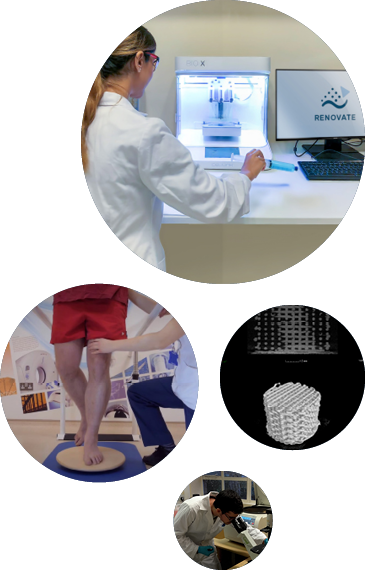
Engineering the future of regenerative medicine
RENOVATE takes up this challenge and targets to deliver an innovative multinational, multi-sectorial, and multidisciplinary research and training programme in biomedical, mechanical, and chemical engineering, manufacturing and biomaterials science. To achieve this, RENOVATE brings together relevant scientific staff from 7 academic institutions, 3 hospitals, and 1 company, ensuring that its researchers and PhD students follow comparable training paths and have outstanding career opportunities in the biomedical engineering sector and beyond.

Objectives
RENOVATE aims to create an innovative multinational, multi-sectoral, and multidisciplinary excellence doctoral network programme to train 10 early-stage researchers (DCs) in medicine, biomaterials, mechanical, chemical or manufacturing engineering and bioengineering.
This overall goal breaks down into a set of specific objectives:
Scientific: Develop a new generation of scaffolds with appropriate biomechanical properties to promote the satisfactory durable regeneration of large osteochondral defects. This ambitious goal breaks down as follows:
- Define patient-specific key functional and mechanical requirements for large osteochondral scaffolds, improving the understanding of cartilage and subchondral bone damage progression and assessing current strategies of osteochondral repair and regeneration at different osteoarthritis stages.
- Produce highly adhesive and biocompatible porous 3D structures that mimic osteochondral tissue native hierarchical structures starting from alternative biomaterials, bioinks and nanocomposites, to enhance the physicochemical and biological behaviour and the mechanical fixation of the scaffold to the bone.
- Develop a novel optimisation methodology, by genetic algorithms and metamodels, to produce Functionally Graded Additive Manufacturing (FGAM) large osteochondral scaffolds and evolve existing 3D printing equipment.
innovative multinational, multi-sectoral and multidisciplinary doctoral network excellence programme
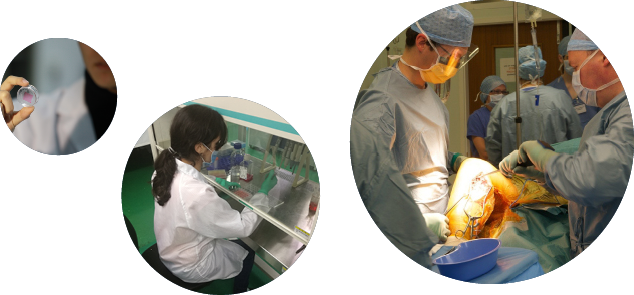
Training: To provide a high-level personalised multidisciplinary training programme both in technical disciplines and transferable skills (such as entrepreneurship, project management, ethical issues, IPR, open access) with the long-term aim of producing scientific leadership both in academic and non-academic sectors.
Dissemination and outreach: Disseminate the methods and tools to a wide spectrum of stakeholders from the scientific community to corporate users; create awareness in the general public about OA and the key progress that RENOVATE will mean to patients and clinicians; encourage vocational careers among young students, with special emphasis on women.

Actions
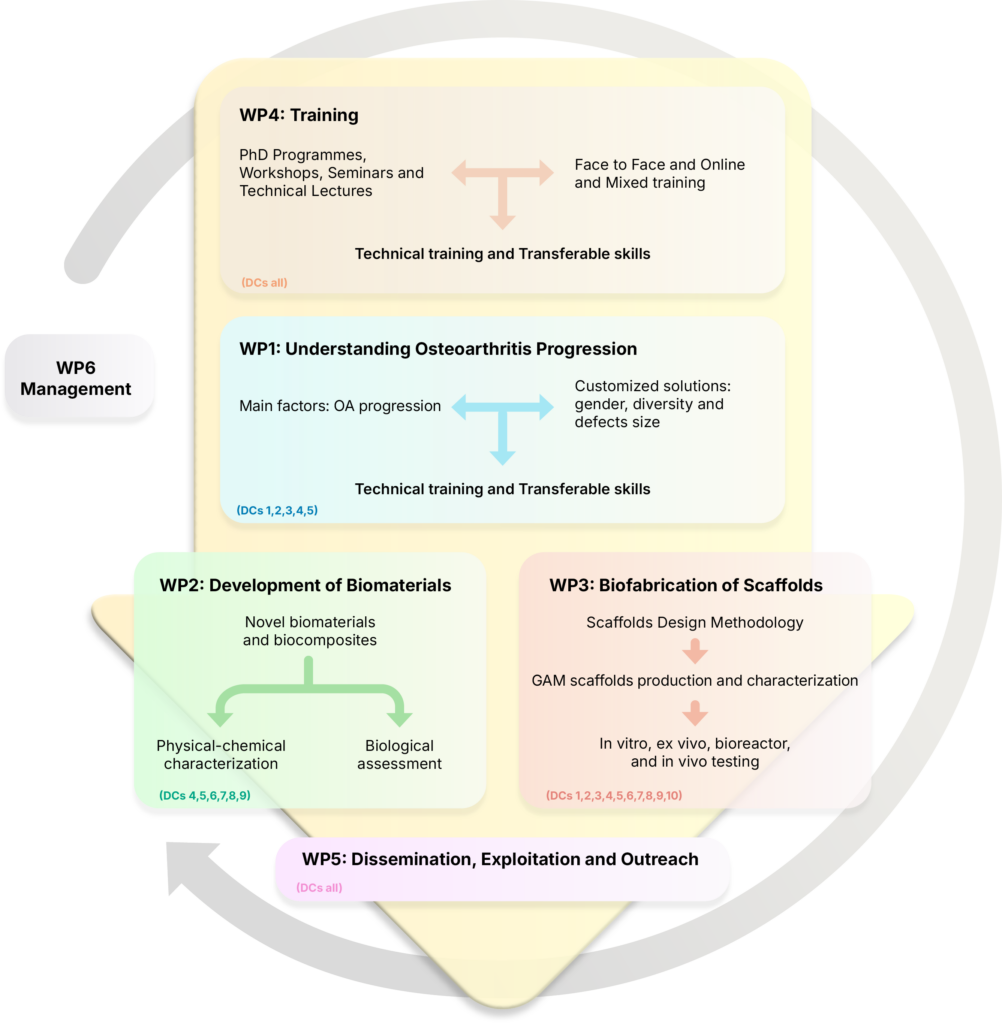
An efficient treatment of osteoarthritis patients needs to be based on the synergistic interaction between novel knowledge on osteochondral damage progression, highly performing structures and materials and the most effective and efficient manufacturing methodology. To enable this interaction, RENOVATE has been structured in three interdependent scientific work packages (WPs). To support the development of the scientific WPs, WP4 will be focused on the development of training activities, WP5 will be devoted to dissemination, exploitation and outreach of the project’s results, and WP6 is dedicated to consortium and project management.
In the designed work programme, each fellow will undertake an Individual Research Project (IRP) with clearly defined objectives, implemented through research, training, dissemination and outreach tasks aligned with one or more RENOVATE WPs. Doctoral Candidates (DCs) will be responsible for completing their assigned tasks and delivering the corresponding outputs. IRP progress will be monitored through a tailored supervision and evaluation framework established by RENOVATE.
Impact

Scientific impacts
- Advance understanding of osteoarthritis (OA) progression.
- Develop Functionally Graded Additive Manufacturing (FGAM) scaffolds:
- Advanced 3D printing and sustainable materials (biopolymers, hydrogels, ceramics, biodegradable metals).
- Regeneration of larger defects (>1.5 cm²).
- Extended immunomodulatory effects and durability (~3 years).
- Address critical questions on subchondral bone remodeling vs. cartilage degeneration, benefiting trauma and orthopedic practice.

Economic & Technological impacts
- Benefit stakeholders: equipment manufacturers, material developers, pharmaceutical companies.
- Reduce healthcare costs: scaffold vs. joint replacement.
- Enable new biomaterials and production methods.
- Contribute to international standards for AM and biomaterials.
- Broader applications in tissue engineering: bone regeneration post-cancer or trauma.
- Support growth in global tissue engineering & biomaterials markets.

Societal impacts
- Improve OA patient quality of life:
- Less pain, fewer invasive surgeries, delayed joint replacement.
- Reduce healthcare system burden (Europe: 1.7 billion people over 60 by 2050).
- Promote environmental sustainability:
- Biodegradable scaffolds, less reliance on rare metals/plastics.
- Safe degradation in the body post-implantation.

Alignment with EU Priorities
- Supports MSCA doctoral training via Osteoarthritis training roadmap.
- Contributes to EU Clusters:
- Cluster 1 (Health) – new tools, technologies, digital solutions.
- Cluster 4 (Digital, Industry & Space) – resilient industry, innovative therapies.